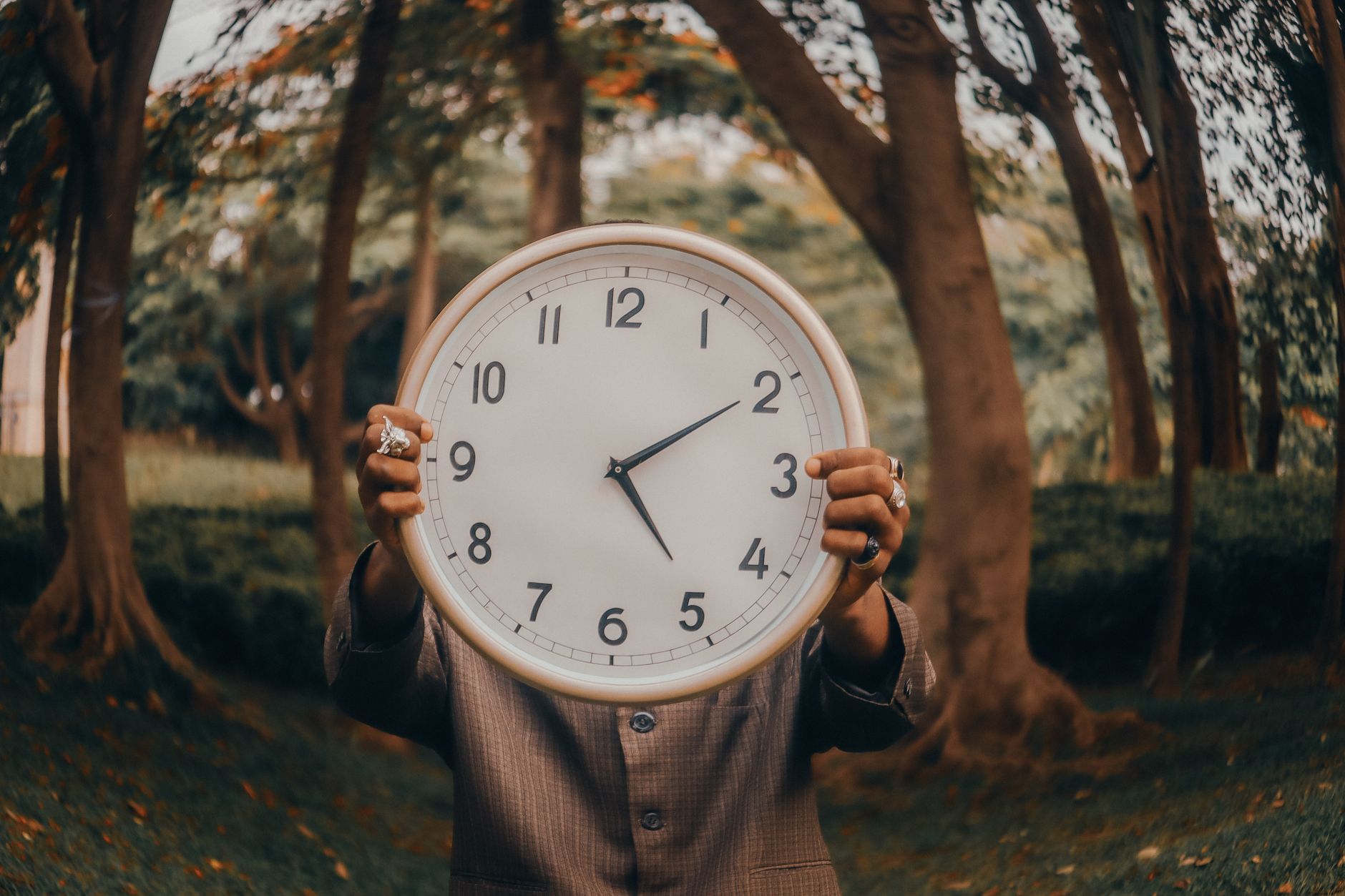
There is a version of me that exists only in my own imagination. He leaves the house ten minutes early. He accounts for traffic. He has never once said, “I just need to grab one thing” and then been gone for forty-five minutes. I admire him enormously. We have never met.
Somewhere in my forties I accepted that I have a condition — not a diagnosis, just a tendency — wherein I believe, with complete sincerity, that any task will take approximately fifteen minutes. Washing the car: fifteen minutes. Writing a difficult email: fifteen minutes. Running to the hardware store for one specific bolt: fifteen minutes. The actual time required by these activities bears no relationship to my estimates. I have started treating my own predictions the way I treat weather forecasts for days that are more than a week out — directionally interesting, not operationally useful.

My wife, Janet, has developed a system. When I tell her how long something will take, she doubles it, adds thirty minutes, and then plans to start dinner anyway. She does not do this cruelly. She does it the way you might adjust for a clock that always runs slow — not because the clock is bad, just because you know the clock. I have watched her do the mental arithmetic in real time. There is a very small pause after I give my estimate, barely a half-second, and then she nods. That nod contains multitudes.
I have tried to fix this. I set extra alarms. I write start times in my calendar instead of just end times. I have read things — not self-help books exactly, but adjacent to them — about the “planning fallacy” and why humans are structurally optimistic about duration. None of it has helped in any lasting way. What has helped, slightly, is just telling the truth. I’ve started saying, “I think it’ll take about thirty minutes, which means it’ll probably take an hour,” and people seem to appreciate the transparency more than the confidence.
Though honestly, when I say “people,” I mostly mean Janet. And she’s still adjusting.